
Telehandler Axle Technology Evolution and Selection Guide in the Global Market by 2026
Introduction: A key node linking energy and terrain
With the growth of global infrastructure construction, the development of large-scale modern agricultural operations, and the increasing complexity of material handling, telescopic forklifts are transforming from auxiliary equipment to essential equipment on construction sites thanks to their "one machine, multiple functions" characteristics. As a key component of this type of multifunctional mechanical equipment, the telescopic forklift axle not only supports the vehicle's weight but also determines the vehicle's traction, steering flexibility, and operational safety on rough terrain.
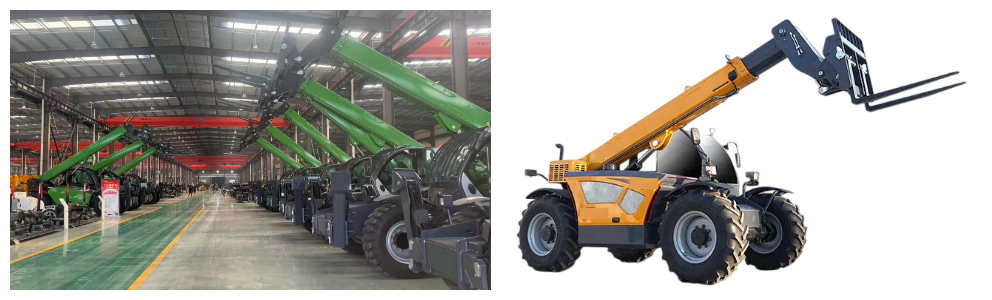
For international B2B buyers, whether purchasing heavy-duty telescopic forks for loading, compact telescopic forks for loading, or seeking OEM support, understanding the latest technology trends and market dynamics for drive axles is key to ensuring a return on equipment investment. This article will provide a detailed analysis of the market outlook, technological innovations, and application practices for telescopic fork drive axles worldwide in 2026.
Industry History: Key Driving Demand in an Expanding Global Market
Market data and growth factors
According to the latest market research, the global multi-purpose telehandler market is growing steadily. The agency forecasts the market to maintain a significant compound annual growth rate (CAGR) from 2026 to 2032. This growth is primarily driven by rising demand in three key areas: first, the construction industry seeking greater efficiency in aerial work and material handling; second, demand for mechanized straw handling and forage loading and unloading in agriculture; and third, demand from the industrial and mining industries for equipment handling in heavy-duty operating conditions.
As sales of the entire vehicle increase, demand for after-sales service (replacement) of high-performance telescopic fork drive axles has also increased. Buyers are no longer satisfied with just “ease of use,” but also seek “durability” and “safety” when driving in difficult conditions and at high speeds.
Basic position of the drive axle
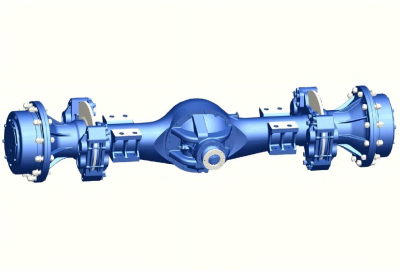
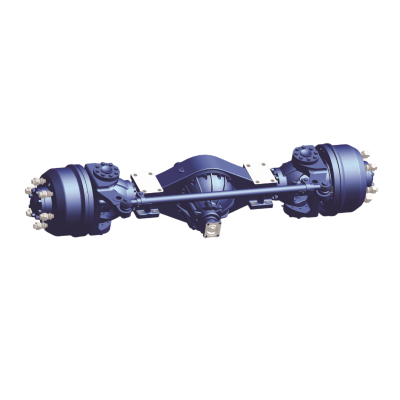
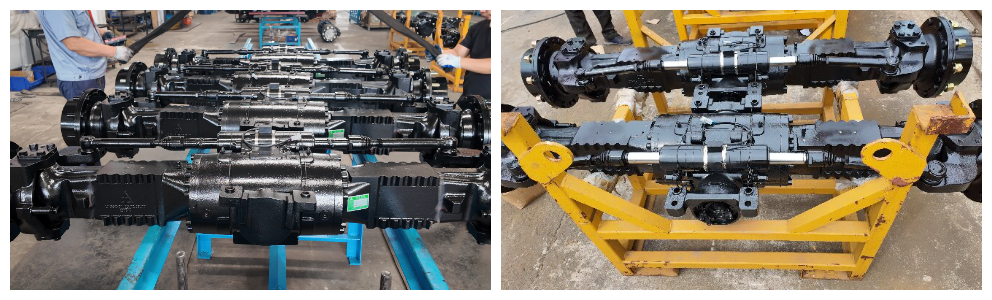
The drive axle is primarily responsible for deceleration and torque multiplication, load bearing, and (in the case of a steering axle) changing direction when loading with telescopic forks. The complexity of the steering axle design directly determines the maneuverability and off-road capability of the vehicle, especially in high-end models with all-wheel drive and multiple steering modes (e.g., front-wheel steering, all-wheel steering, and all-wheel steering). Flexibility and off-road capability.
Analysis of technological trends: the transition from tradition to intelligence and innovation
Popularization of wet braking and compaction technology
In the past, dry brakes were susceptible to increased wear due to dust and dirt ingress in harsh operating conditions. Today, fully hydraulic wet braking has become the standard configuration for high-quality telescopic axles.
Specifications:The wet brake axle is completely immersed in oil inside the axle body, which not only provides large braking torque, but also provides advantages such as easy maintenance, good heat dissipation, no wear and dust.
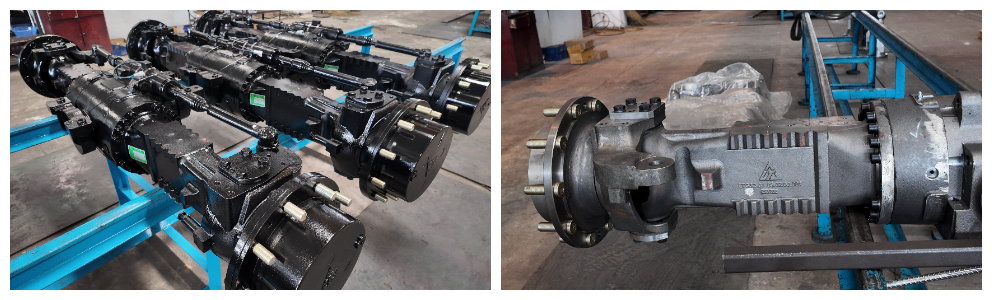
Innovative sealing technology:To meet extreme operating conditions, the drive axle sealing technology has been upgraded from a single-layer oil seal to a multi-layer protection technology. For example, the use of imported double-lip oil seals, cassette oil seals, and a triple sealing structure consisting of a sealing ring, bonding, and increased surface pressure on the connecting surface effectively prevents dirt and water penetration, significantly extending the service life of the axle in swampy and muddy environments.
Flexibility and cross-country ability of the steering drive axle
For equipment such as telescopic forks, which need to move flexibly in tight construction sites, steering angle is a key performance indicator.
High Angle Rotation Technology:Modern drive axles with telescopic forks use constant-velocity universal joints, which allow the steering wheel to be turned more freely from the traditional 20°-30° to 40° or even more than 50°. This significantly reduces the vehicle's turning radius and improves maneuverability in tight spaces.
Swing bridge design:To adapt to uneven ground, part of the drive axle is designed as a pivot axle. For example, the front axle (or rear axle) of some models has a specific steering angle so that the tires always remain firmly on the ground, ensuring maximum traction in off-road conditions. This design, combined with the all-wheel drive system, allows a forklift with telescopic forks to easily overcome slopes of over 50%.
Breakthroughs in Chemistry and Materials Science
With the development of heavy-duty telescopic forklifts (with a lifting capacity of over 4 tons) and long extension distances, extremely high requirements have been placed on the load capacity of the drive axle.
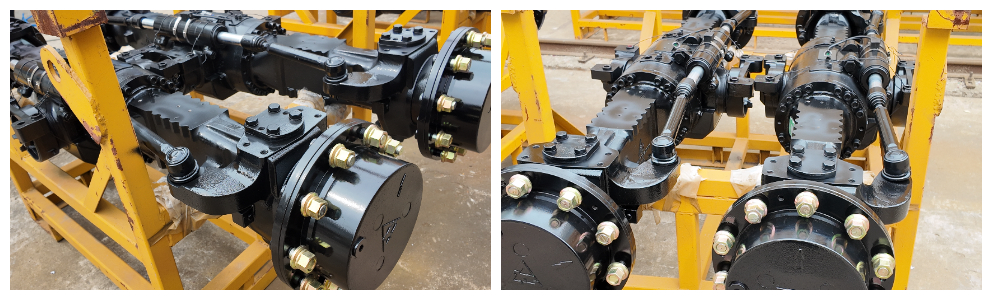
Bearing and torque:Modern, high-performance telescopic axles typically utilize high-strength cages optimized using finite element analysis. Taking a typical 16-ton telescopic axle mounted on a fork as an example, its rated dynamic load can reach 8 tons, and its output torque can reach 34,000 Nm, sufficient to meet the needs of transporting large construction components.
Gear reinforcement:The main axle core of the drive axle was strengthened with a spiral bevel gear pair and a wheel-side gear pair, and the gear grinding process and the use of high-strength alloys significantly improved the reliability and fatigue life of the transmission.
A look at the production process and product application
Precision manufacturing and assembly
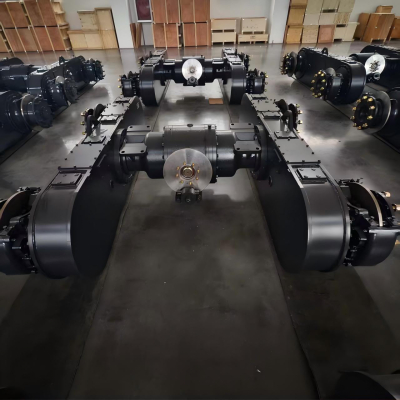
The production process of high-quality Telescopic Handler Drive Axle is the art of metal processing and precision assembly.
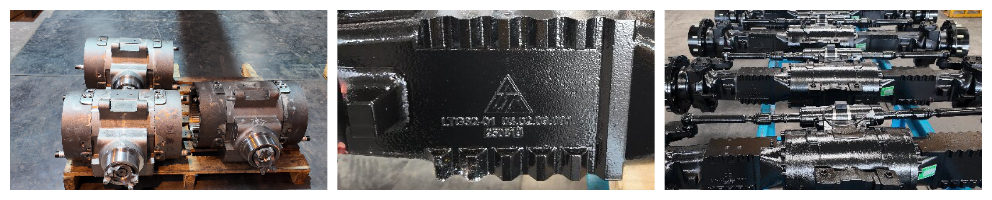
Case processing:Typically, ductile iron or high-quality cast steel parts are used, and the key hole position machining is completed by one-time clamping on a five-axis machining center to ensure alignment of the differential and main gear bearing holes.
Manufacturing of gears:From cutting, forging, normalizing to roughing, carburizing and quenching, the final grinding process is used to ensure smooth and low-noise gear engagement. The accuracy typically reaches ISO 6 or higher.
Assembly and testing:The differential assembly and lateral brake unit are pre-installed in a dust-free workshop and then fully assembled. Before deployment, it must undergo rigorous load testing to check for operating noise, temperature rise, and leakage at rated torque.
Application Scenario Example
Application in agriculture:In wet conditions, a telescopic forklift equipped with a wet brake axle can transport straw bales through muddy conditions for extended periods without worrying about sediment damaging the brake system.
Building demolition:In devastated environments, a heavy-duty drive axle with wheel-side braking and reinforced guards can withstand gravel impacts and provide powerful traction, allowing you to haul buckets of gravel out of ruins.
Answers to frequently asked questions (FAQs)
Question 1: How do I choose the right drive axle for my telescopic forklift? What are the main technical parameters?
Answer:The choice of drive axle should be based on the load rating and operating scenario of the entire machine.
The following three main technical parameters are mainly considered:
Nominal dynamic load and maximum input torque:They determine how much impact force the axle can withstand, as well as the torque transmitted to the engine. It is usually measured in tonnage (e.g. 10 ton, 16 ton) and Nm.
Braking type:If your equipment frequently operates in dirty, dusty, or wet conditions, be sure to choose a fully enclosed wet brake axle. If you only operate in a flat, dry warehouse environment, installing a dry brake axle can reduce costs.
Wheel track and gear ratio:It should match the wheel track design and tire size of the vehicle, and at the same time, the appropriate main gear ratio should be selected according to the engine characteristics and maximum speed requirements.
Question 2: What is a "steering axle"? What is the difference between it and a normal support axle?
Answer:In vehicles with telescopic forks, the front or rear axle is typically responsible not only for steering but also for steering the vehicle while in motion. This type of axle is called the drive axle.
Its internal structure is much more complex than that of conventional support axles, including steering knuckles, universal joints (or ball joints), and half shafts. Conventional support axles only serve as load-bearing and drive axles, while drive axles must simultaneously transmit power to a wheel that can turn left and right. High-quality telescopic forklifts are typically equipped with drive axles with four-wheel steering, which allows for a "crab" mode and significantly improves maneuverability.
Conclusion and Call to Action
As the global telehandler market becomes more specialized, high-performance, and intelligent, the telehandler drive axle, as a core component, is undergoing profound technological changes. Modern drive axles—from high-torque design to exceptional sealing and steering flexibility—have become key to maximizing the overall machine's performance.
As a professional supplier of transmission systems for construction equipment, we strive to provide high-quality drive axle solutions that meet international standards. Whether you need a lightweight drive steering axle suitable for compact telescopic fork loading or a heavy-duty, ultra-high-load axle assembly for heavy-duty telescopic fork loading, our technical team can offer you custom designs and reliable technical support.
[Act now]
OEMs and aftermarket customers worldwide can contact us for detailed drawings or prototype testing. Let's work together to develop the most reliable drive system to help your equipment handle the most challenging operating conditions.